
What to Expect After ESG: Recovery, Diet & Weight Loss Timeline

Endoscopic Sleeve Gastroplasty Timeline: Recovery, Diet & Weight Loss Month by Month
Patients often ask the same question before ESG: “What happens after the procedure?” The answer is not only about recovery. It is also about hydration, diet progression, learning smaller portions, returning to activity, and watching weight loss develop over time.
Endoscopic Sleeve Gastroplasty (ESG) is performed through the mouth with an endoscope and internal sutures, without external abdominal incisions or surgical removal of stomach tissue.
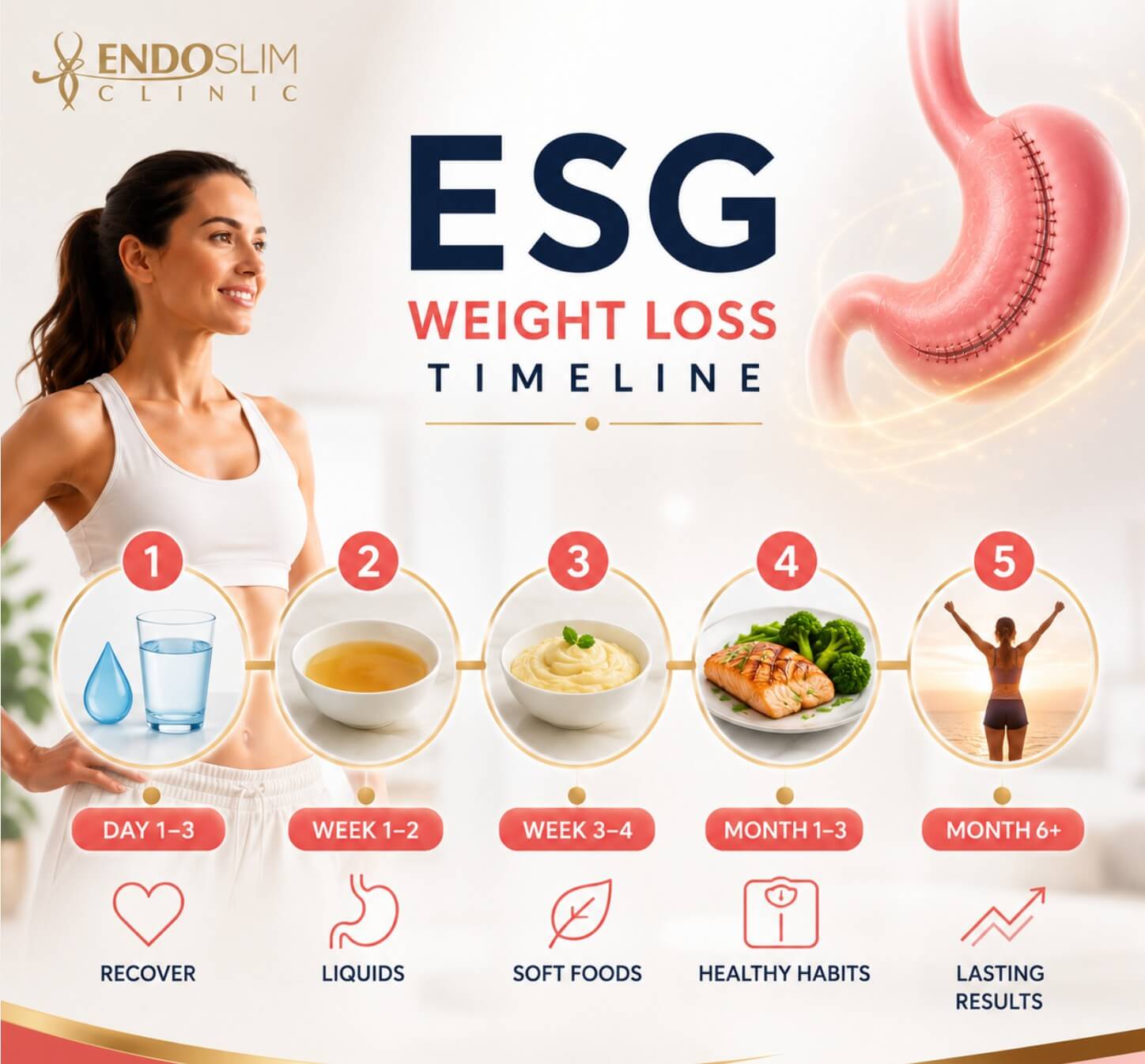
ESG Recovery and Weight Loss Timeline
This is a general educational timeline. Your exact diet, activity restrictions, medications, and follow-up schedule should come from your treating physician.
0
Procedure Day
ESG is performed endoscopically through the mouth. Internal sutures reshape the stomach into a smaller, tube-like configuration without removing part of the stomach.
Many patients are discharged the same day after recovery and observation. The first goal is not weight loss—it is safe recovery, hydration, and controlling nausea or discomfort.
Learn more about the procedure on our Endoscopic Sleeve Gastroplasty in Brooklyn & NYC page.
HRS
The First 24–72 Hours
Some patients experience nausea, abdominal pressure, cramping, fatigue, or a feeling of tightness. Medication may be prescribed to help manage symptoms.
Hydration is especially important. Patients generally sip fluids slowly rather than drinking large amounts at once.
For more on what early recovery can feel like, see What Actually Happens After Endoscopic Sleeve Gastroplasty?
1
Week 1: Liquids, Hydration & Healing
The stomach is still healing. The diet is typically liquid-focused, with emphasis on hydration and protein according to the patient’s prescribed plan.
Light walking is commonly encouraged, but strenuous exercise and heavy lifting may still be restricted.
2
Week 2: Transition Toward Soft Foods
As tolerated and cleared by the care team, some patients begin transitioning from liquids toward soft or pureed foods.
This is often when patients begin noticing the practical effect of ESG: much smaller portions can feel satisfying.
WKS
Weeks 3–4: Building a New Eating Routine
Food texture gradually advances based on tolerance and medical guidance. Patients begin practicing slower eating, smaller bites, portion awareness, and stopping at the first signs of fullness.
By around one month, some patients are transitioning toward small portions of regular solid foods.
MO
Month 1: Early Weight Loss Becomes Visible
At this stage, weight change may become more noticeable, but the number varies widely. One published meta-analysis reported pooled total body weight loss of roughly 8.7% at one month.
Early loss should not be treated as a promise or target. Hydration, protein intake, recovery, and preserving lean mass remain important.
MO
Month 3: Clothes, Waist Size & Portion Changes
By three months, many patients notice more than a change on the scale. Clothing may fit differently, waist circumference can decrease, and smaller portions may feel more natural.
The quality of the follow-up program matters. ESG is a tool—not a replacement for nutrition, physical activity, sleep, and behavioral support.
MO
Month 6: A Major Progress Checkpoint
Six months is an important point to review weight loss, body composition, nutrition, exercise, hunger, and any medications that may be part of the treatment plan.
A meta-analysis of ESG studies reported pooled total body weight loss of about 15.3% at six months.
See our guide to how much weight you can lose in six months for a broader discussion of weight-loss timelines in pounds.
MO
Month 12: One-Year ESG Results
By one year, the focus is increasingly on maintaining the habits that helped produce the result. Published studies report different averages depending on the population and follow-up program.
One meta-analysis reported pooled total body weight loss of approximately 17.1% at 12 months, while the randomized MERIT trial reported 13.6% mean total body weight loss at 52 weeks.
For a patient-focused overview, see How to Lose Up to 20% of Your Body Weight Without Traditional Weight Loss Surgery.
YRS
Year 2 and Beyond: Maintenance Matters
ESG does not remove the biological tendency toward weight regain. Long-term success still depends on maintaining smaller portions, preserving muscle, staying active, and addressing hunger or metabolic changes early.
In selected patients, additional medical weight-loss treatment or ESG revision may be considered if weight regain develops.
What Does 15%–20% Weight Loss Mean in Pounds?
Percentages are useful scientifically, but patients usually want to know what they mean on the scale.
| Starting Weight | 15% Total Weight Loss | 20% Total Weight Loss |
|---|---|---|
| 180 lbs | 27 lbs | 36 lbs |
| 200 lbs | 30 lbs | 40 lbs |
| 225 lbs | 33.8 lbs | 45 lbs |
| 250 lbs | 37.5 lbs | 50 lbs |
| 300 lbs | 45 lbs | 60 lbs |
How Much Does ESG Reduce the Stomach?
ESG changes the shape and functional volume of the stomach without surgically removing stomach tissue.
During ESG, a series of full-thickness endoscopic sutures are placed to fold and shorten the stomach. This creates a smaller functional reservoir that can help patients feel satisfied with less food.
Different sources describe the degree of stomach-volume reduction somewhat differently because technique and measurement methods vary. To see the procedure from a surgical perspective, read our article on ESG and 75–80% stomach reduction.
What Side Effects Can Happen During ESG Recovery?
Short-term symptoms can include nausea, abdominal discomfort, cramping, reflux symptoms, bloating, and temporary difficulty tolerating larger volumes of liquid or food.
Serious complications are less common but can occur, which is why patients should follow their treating physician’s instructions and promptly report concerning symptoms.
For a more detailed discussion, see ESG side effects and what patients should know.
ESG Timeline vs Surgical Gastric Sleeve Timeline
ESG and surgical sleeve gastrectomy can both support meaningful weight loss, but they are different procedures.
Endoscopic Sleeve Gastroplasty
Performed through the mouth with an endoscope. Internal sutures reshape the stomach. No external abdominal incisions and no portion of the stomach is removed.
Surgical Sleeve Gastrectomy
A laparoscopic surgical procedure that permanently removes a large portion of the stomach. Average weight loss is typically greater, but it is also a more invasive operation.

Continue Learning About ESG & Non-Surgical Weight Loss
ESG Recovery & Weight Loss FAQ
1. How painful is ESG recovery?
2. How long will I be off work after ESG?
3. When can I drink normally after ESG?
4. When can I eat solid food after ESG?
5. How much weight can I lose in the first month after ESG?
6. How much weight can I lose in 6 months after ESG?
7. How much weight can I lose after one year of ESG?
8. Can the stomach stretch after ESG?
9. Can ESG be repeated or revised?
10. What if I stop losing weight after ESG?
11. Is ESG recovery easier than gastric sleeve surgery?
12. Is ESG permanent?
Considering ESG in New York?
Dr. Alexander Shapsis and the EndoSlim Clinic NY team can review your BMI, weight history, previous treatment attempts, medical conditions, and goals to determine whether Endoscopic Sleeve Gastroplasty may be appropriate for you.
Call 877-749-3633 or Book Online
Schedule an ESG Consultation


-
Mon-Friday: 08:30 - 6:00Saturday: ClosedSaturday: Closed