
Ozempic® vs Zepbound® for Weight Loss: Semaglutide vs Tirzepatide Compared
Ozempic® vs Zepbound® for Weight Loss: Semaglutide vs Tirzepatide Compared
Ozempic® and Zepbound® are two of the most discussed injectable medications in weight management, but they are not the same drug and they do not have identical FDA indications.
Ozempic contains semaglutide, a GLP-1 receptor agonist. Zepbound contains tirzepatide, which activates both GIP and GLP-1 receptors. For patients primarily interested in weight loss, the comparison is more accurately semaglutide vs tirzepatide.
Ozempic vs Zepbound: Key Differences
| Feature | Ozempic® | Zepbound® |
|---|---|---|
| Active ingredient | Semaglutide | Tirzepatide |
| Mechanism | GLP-1 receptor agonist | GIP + GLP-1 receptor agonist |
| Injection frequency | Once weekly | Once weekly |
| Brand’s primary FDA role | Type 2 diabetes | Chronic weight management |
| Weight-management counterpart | Wegovy® | Zepbound® |
| Same-ingredient diabetes brand | Ozempic® | Mounjaro® |
What Is Ozempic® (Semaglutide)?
Semaglutide activates the GLP-1 receptor and can reduce appetite and increase satiety.
Ozempic is a semaglutide injection approved for type 2 diabetes. For chronic weight management, the FDA-approved semaglutide product is Wegovy®. Patients often use “Ozempic” as a general term for semaglutide, which can make comparisons confusing.
What Is Zepbound® (Tirzepatide)?
Tirzepatide activates both GIP and GLP-1 receptors.
Zepbound is tirzepatide for chronic weight management in eligible patients. The same active ingredient is marketed as Mounjaro® for type 2 diabetes.
Zepbound vs Semaglutide: Which Helps People Lose More Weight?
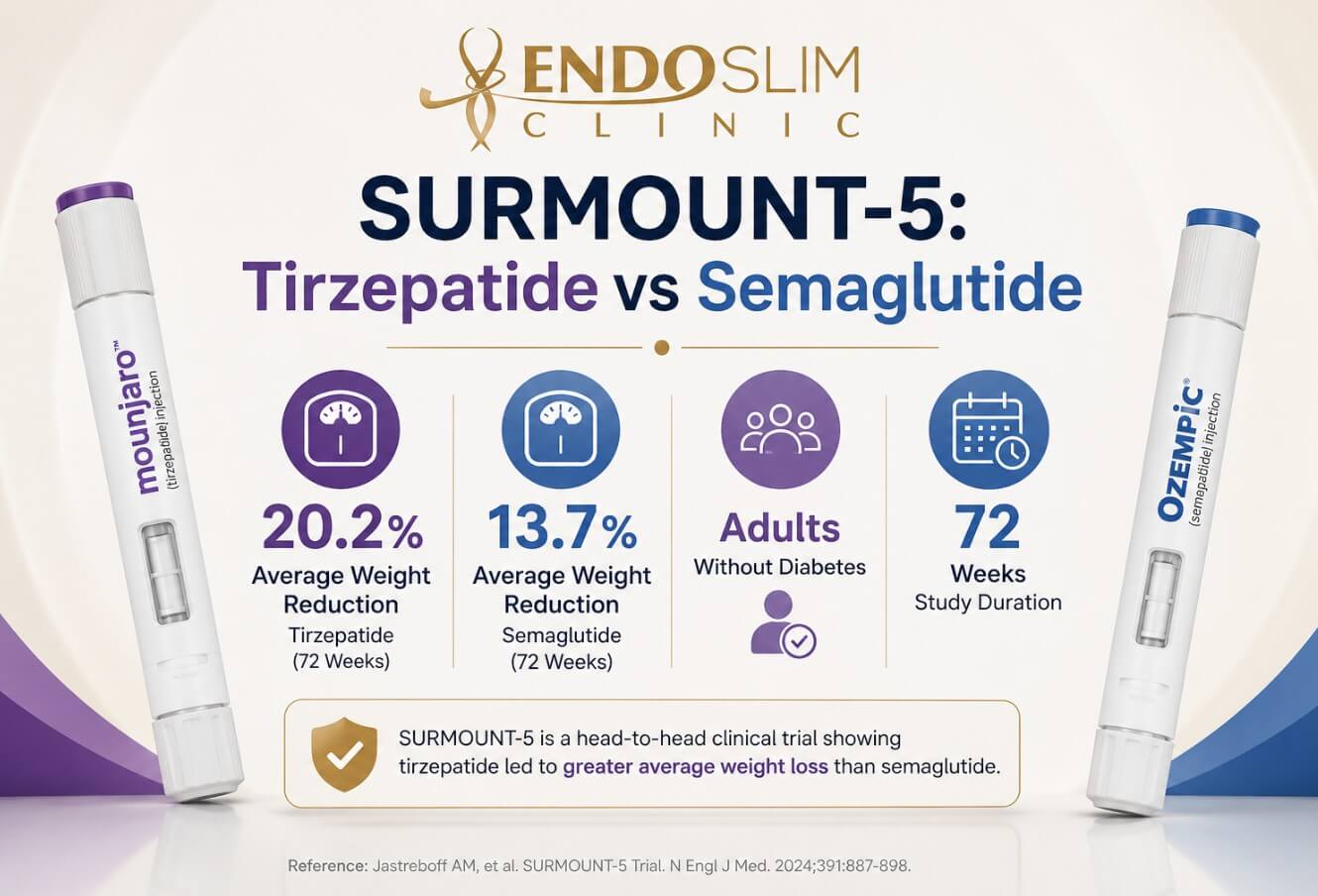
The strongest comparison comes from a randomized trial that directly compared tirzepatide with semaglutide.
SURMOUNT-5: Tirzepatide vs Semaglutide
Published in the New England Journal of Medicine in 2025.
SURMOUNT-5 randomized 751 adults with obesity, or overweight with a weight-related condition, who did not have type 2 diabetes. Participants received the maximum tolerated dose of tirzepatide or semaglutide for 72 weeks.
Average body-weight reduction
Average body-weight reduction
Tirzepatide also produced a greater average reduction in waist circumference: 18.4 cm compared with 13.0 cm with semaglutide. Participants taking tirzepatide were more likely to achieve weight-loss thresholds of at least 10%, 15%, 20%, and 25%.
Read the SURMOUNT-5 study in the New England Journal of Medicine.
Why Might Tirzepatide Produce More Weight Loss?
Semaglutide activates the GLP-1 receptor. Tirzepatide activates both GIP and GLP-1 receptors. This dual incretin activity may contribute to tirzepatide’s greater average weight-loss effect in head-to-head research.
That does not mean every patient who does well on semaglutide should switch. Effectiveness must be balanced against tolerability, medical history, insurance coverage, access, and the ability to stay on treatment.
Ozempic vs Wegovy vs Mounjaro vs Zepbound
Ozempic®
SemaglutidePrimarily used under FDA labeling for type 2 diabetes.
Wegovy®
SemaglutideThe semaglutide brand labeled for chronic weight management.
Mounjaro®
TirzepatideThe tirzepatide brand labeled for type 2 diabetes.
Zepbound®
TirzepatideThe tirzepatide brand labeled for chronic weight management.
Ozempic vs Zepbound Side Effects
Both medications commonly cause gastrointestinal symptoms, especially during dose escalation. These may include nausea, diarrhea, vomiting, constipation, abdominal discomfort, indigestion, and reduced appetite.
For practical physician-guided strategies, read How to Prevent Ozempic® & Wegovy® Side Effects: Dr. Shapsis’ Tips.
Both also carry important warnings and contraindications. A clinician should review your medical history, other medications, pregnancy plans, gastrointestinal history, and thyroid-related risk factors before prescribing.
Can You Switch From Ozempic to Zepbound?
Some patients transition from semaglutide to tirzepatide because of inadequate weight loss, side effects, insurance changes, availability, or changing treatment goals.
The medications are not dose-equivalent. Do not convert milligrams yourself. The timing and starting dose after a switch should be determined by the prescribing clinician.
Can You Take Ozempic and Zepbound Together?
Using semaglutide and tirzepatide together is generally not recommended. They affect overlapping incretin pathways. If you are transitioning between therapies, follow your prescriber’s instructions rather than overlapping them yourself.
What Happens When Weight Loss Slows?
As body weight decreases, hunger may increase, fullness signals can change, and energy expenditure may fall. These adaptations can contribute to a plateau even when treatment initially worked well.
Read Why Your Body Fights Weight Loss and How Much Weight Can You Lose in 6 Months? for more detail.
What Happens When You Stop Ozempic® or Zepbound®?
Planning for maintenance matters before medication is discontinued.
For some patients, appetite increases after GLP-1 treatment is stopped and weight regain can occur over time. That does not mean treatment “failed.” Obesity is a chronic condition, and the biological pressures affecting appetite and body weight can return when treatment is removed.
Read What Happens When You Stop Taking Ozempic®? for a detailed explanation of appetite and weight regain after semaglutide.
If you are taking tirzepatide, see our guide to avoiding weight gain after Zepbound®.
For a deeper explanation of why the body can resist weight loss and defend a previous weight, read Why Your Body Fights Weight Loss.
What If You Do Not Want to Stay on Weight-Loss Injections?
For some patients, the bigger question is medication vs a gastric balloon vs ESG—not simply Ozempic vs Zepbound.
Explore physician-supervised semaglutide care.
Mounjaro® & Zepbound® TirzepatideExplore physician-supervised tirzepatide weight-loss care at EndoSlim Clinic NY.
Allurion® Smart CapsuleLearn about the swallowable gastric balloon.
Orbera® Gastric BalloonExplore temporary gastric balloon therapy.
Endoscopic Sleeve Gastroplasty (ESG)Explore incisionless endoscopic stomach-volume reduction.
Ozempic vs Zepbound FAQ
These are some of the most common questions patients ask when comparing semaglutide and tirzepatide for weight loss.
1. Is Zepbound better than Ozempic for weight loss?
2. Which causes more weight loss: semaglutide or tirzepatide?
3. How long does it take to start losing weight on Zepbound?
4. Why am I not losing weight on Ozempic?
5. What should I do if Ozempic stops working or I hit a plateau?
6. Can Zepbound work if Ozempic did not work for me?
7. Can I switch from Ozempic to Zepbound?
8. Which has more side effects: Ozempic or Zepbound?
9. What happens when you stop Ozempic or Zepbound?
10. Will I regain weight after stopping Zepbound?
11. Do I have to take Ozempic or Zepbound for life?
12. Which is better if I do not have diabetes: Zepbound or Wegovy?

Ozempic, Zepbound—or a Different Weight Loss Approach?
At EndoSlim Clinic NY, Dr. Alexander Shapsis can review your weight history, previous GLP-1 use, medical conditions, side effects, goals, and long-term preferences to determine which approach may be appropriate.
Schedule a ConsultationTrusted Sources & Further Reading
- New England Journal of Medicine — SURMOUNT-5, 2025
- PubMed — Tirzepatide as Compared with Semaglutide for the Treatment of Obesity
- FDA — Zepbound® (tirzepatide) labeling
- FDA — Ozempic® (semaglutide) labeling
- FDA — Wegovy® prescribing information
- GoalBMI Wellness — Semaglutide Statistics 2026
- GoalBMI Wellness — Tirzepatide Statistics 2026


-
Mon-Friday: 08:30 - 6:00Saturday: ClosedSaturday: Closed